StoryEducation, Identity & Opportunity
HBCU or PWI: What Are Black Students Really Choosing Between?
The choice between an HBCU and a predominantly white institution is often framed around prestige, resources, or tradition. For Black students, it can also be a decision about belonging, identity, opportunity, and what kind of environment will help them become who they want to be.
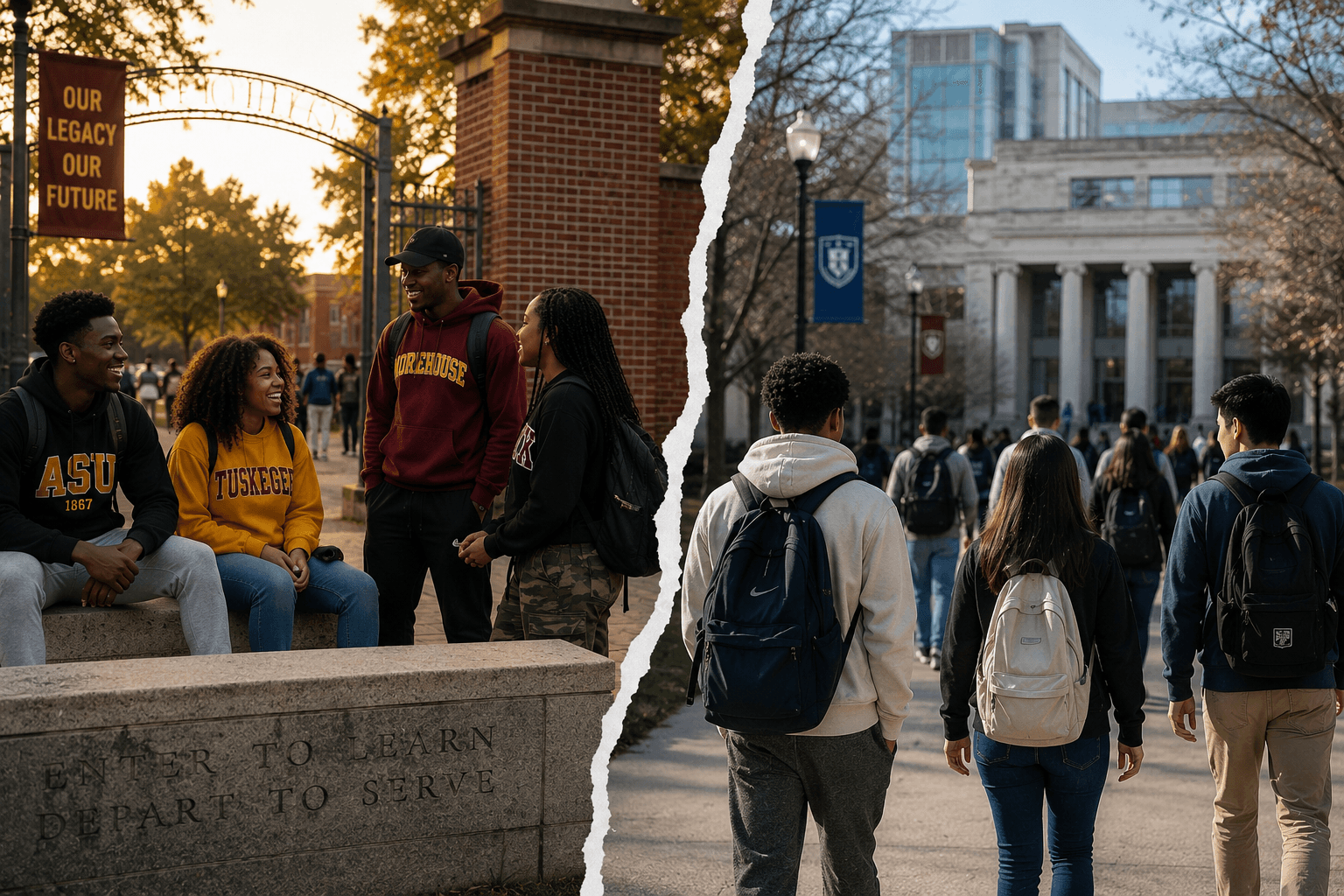
Choosing a college is supposed to be about academics, cost, location, career goals, and the kind of campus experience a student wants. For Black students, another question can sit underneath all of those decisions: where will I feel like I belong?
That question can lead to two very different college experiences. Historically Black colleges and universities were built because Black students were excluded from much of American higher education. Predominantly white institutions have historically held more resources, larger endowments, broader academic offerings, and access to networks that often carry significant professional influence.
Today, Black students can succeed in either environment. The more interesting question is not which kind of school is universally better. It is what students are actually choosing between when they decide where to spend some of the most formative years of their lives.
Belonging is not a soft benefit
College rankings are good at measuring things that can be counted. Graduation rates, class sizes, research spending, admissions selectivity, faculty credentials, and alumni earnings all help families evaluate schools.
Belonging is harder to put on a spreadsheet.
At an HBCU, a Black student may enter classrooms where professors, administrators, classmates, alumni, traditions, and campus history reflect parts of their own experience. They may spend less energy wondering whether they are the only Black person in the room or whether they have been asked to represent an entire race in a classroom discussion. For some students, that creates space to focus differently on becoming a scholar, leader, artist, engineer, entrepreneur, or whatever else they came to college to become.
That experience should not be dismissed as comfort. Feeling seen can affect confidence, participation, mentorship, networking, and whether someone believes an institution was built with people like them in mind.
More resources can create more options
The case for many PWIs is also real.
Some have enormous endowments, expansive research facilities, specialized academic programs, global study opportunities, large recruiting operations, and alumni networks embedded throughout major industries. A student interested in a highly specific field may simply find more courses, laboratories, faculty, internships, or funding at a larger institution.
For families making a decision with major financial consequences, those differences matter. If one university offers significantly more aid, stronger facilities, or a clearer pipeline into a student's chosen profession, choosing it is not a rejection of Black culture. It may simply be the best educational or financial decision available.
There is also danger in assuming a Black student attending a PWI is entering a culturally empty environment. Many PWIs have vibrant Black student organizations, fraternities and sororities, cultural centers, faculty networks, alumni communities, and friendships that become deeply important parts of a student's experience.
The question is rarely as simple as culture at one school and opportunity at the other.
HBCUs should not have to be perfect to be valuable
Conversations about HBCUs sometimes swing between celebration and criticism.
Supporters may describe them as magical places of Black excellence, while critics point to administrative frustration, aging facilities, housing shortages, financial constraints, or fewer resources than wealthier universities. Both experiences can exist at the same time.
HBCUs should be accountable to their students. Students paying tuition deserve functioning systems, quality housing, strong academics, responsive administration, and institutions prepared to support them from enrollment through graduation.
But there is also something unfair about demanding that institutions created under exclusion compete as if they began the race with the same resources. Many of the country's most powerful universities accumulated land, wealth, donors, research infrastructure, and institutional influence over generations in which Black colleges operated with dramatically fewer resources.
An HBCU should not get a free pass because of its history. Its history should, however, be part of how we understand the conditions under which it has had to build.
A PWI can prepare you for the world, but so can an HBCU
One argument students sometimes hear is that attending a PWI better prepares Black students for the “real world” because most workplaces will not be predominantly Black.
There is some logic in learning to navigate environments where you may be culturally underrepresented. Many Black professionals will spend careers doing exactly that.
But the idea also carries an assumption worth challenging. Why should being surrounded by Black people be treated as less representative of reality? Black communities contain enormous differences in class, geography, politics, religion, nationality, sexuality, personality, ideology, and experience. An HBCU is not an escape from diversity or difficulty simply because many of the students are Black.
There may also be value in spending several years in an environment where Black excellence is ordinary rather than exceptional. A student can see Black professors, researchers, presidents, artists, engineers, doctors, entrepreneurs, and classmates occupying every kind of role without their race being the most unusual thing about them.
That can prepare someone for the world in a different way. Instead of first learning how to exist as a minority, they may have space to develop a stronger understanding of themselves before entering environments that will constantly remind them that they are one.
Cost can change the entire conversation
The emotional and cultural parts of this decision matter, but college is also a major financial decision.
A student may love the idea of an HBCU and receive a better aid package from a PWI. Another may be admitted to a prestigious university but receive significant scholarship support from an HBCU. Families may be comparing not just institutions but four years of tuition, housing, travel, loans, and the possibility of graduating with debt that shapes a student's choices for years afterward.
That complicates any simple advice about where Black students “should” go.
Choosing an HBCU should not become a test of Black loyalty. Choosing a PWI should not be treated as proof that someone values prestige over community. Students deserve enough information to compare the full experience: academic programs, cost, graduation outcomes, career access, campus culture, support systems, and whether they can picture themselves thriving there.
The best choice may be the place where those factors come together differently for each student.
Maybe the real question is what kind of person you want to become there
There is no single Black college experience because there is no single Black student.
One person may need the cultural affirmation of an HBCU after spending years as one of the few Black students in school. Another may actively want a campus where they encounter unfamiliar cultures and perspectives. Someone else may choose almost entirely around a specific academic program, scholarship, city, athletic opportunity, or career connection.
All of those choices can be legitimate.
What matters is that Black students are able to make them without being told that one institution automatically represents ambition while the other represents identity. Education is more complicated than that. So is belonging.
HBCUs and PWIs can both produce extraordinary Black graduates. They can also both fail individual students. The name on the gate cannot determine what someone will become inside it.
Perhaps the better question is not whether a Black student should choose an HBCU or a PWI.
It is whether the place they choose gives them the education, support, challenge, community, and opportunity they need to become more fully themselves.
Your perspective
Stories like this are shaped by the people closest to them.
Membership is free. Contributors can follow a brief they shaped through its Perspective Trail once the story publishes.